
Why Is an AI Readiness Assessment the Key to Growth?
Artificial intelligence (AI) has experienced rapid growth over the past few years. In just a short time, it’s gone from experimental tech to a core component of staying competitive. Today, 88% of those surveyed say they use AI regularly, up from 78% in 2024. Organizations are racing to integrate AI into all their operations, customer support and decision-making. However, just because you can dive into the deep end doesn’t mean you should.
An AI readiness assessment provides you with the proper foundation to see where you can support AI and where you need a little extra attention. Without this, AI projects help in some areas, but often fail to translate into actual value. Strategic AI initiatives need to align with real operational goals to work, and an assessment shows you which paths to take.
What Is AI Readiness?
AI readiness is your organization’s ability to integrate AI tools into the business. That includes adopting, integrating and turning the tech into a reliable tool. Just testing out AI tools or deploying small-scale pilots doesn’t mean your entire business can handle full AI integration. True readiness means businesses can consistently translate AI outputs into repeatable, helpful business outcomes.
A comprehensive AI readiness assessment evaluates multiple business dimensions:
- Business strategy
- Leadership alignment
- Data quality, governance and availability
- Integration capabilities
- Technology stack and security
- Talent to maintain AI
- Risk and compliance
Basically, does the AI add value? Does it fit with your operations? Can you use it to meet measurable goals? If AI isn’t making business success easier, it’s not right for your needs.
Signs You Need an AI Readiness Assessment
While your organization might recognize AI’s potential, translating that into results is challenging. Determining whether your business is ready requires thorough analysis. Without it, you risk operational productivity and wasted investments. An AI readiness assessment identifies any gaps and provides a path to sustainable AI adoption. Here are some signs you need an assessment:
1. Fragmented Data
If critical data resides in isolated systems and you have inconsistent definitions with minimal governance, AI performance will suffer. Analytics teams will have to spend time cleaning and reconciling data. That takes away from developing models. You need cohesive, high-quality data before scaling AI initiatives.
2. High Interest, Unclear Direction
Multiple departments might request AI solutions without a clear strategy or shared priorities. A vague sense of “we need AI” leads to disconnected experiments that don’t push the entire business forward. Projects often produce short-term insights, but fail to scale beyond a single team. A readiness assessment helps establish a roadmap that pinpoints the most valuable uses.
3. Infrastructure and Integration Limitations
On-premise platforms, limited cloud readiness and rigid integrations just create bottlenecks for real-time or high-volume workloads. These environments will restrict model deployment and scaling. The infrastructure needs to be in place before your team moves to advanced AI capabilities.
4. Skill Gaps
Organizational success with AI also depends on people. Teams uncertain about AI’s impact or groups lacking experience in AI and data science can slow down adoption. A readiness assessment can tell you what skill sets are needed for your AI deployment and where you can train, hire or partner with teams for long-term AI success.
What an AI Readiness Assessment Evaluates
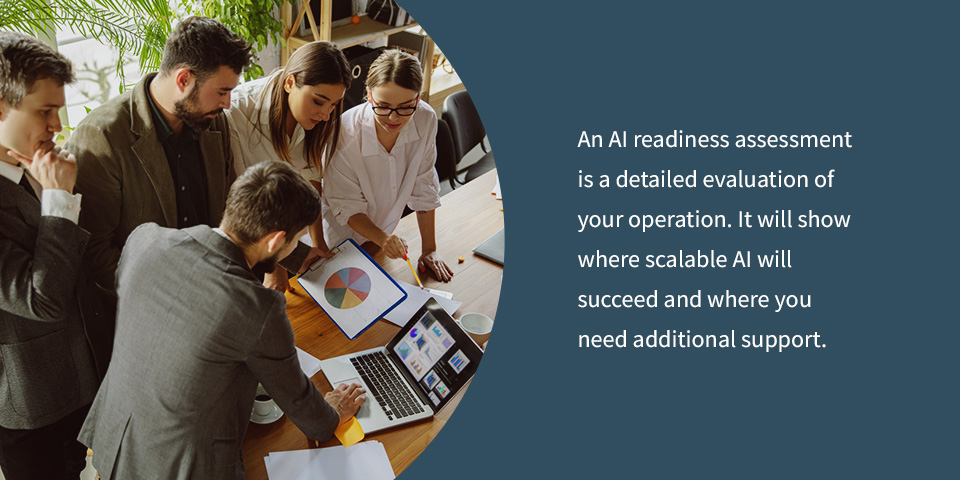
An AI readiness assessment is a detailed evaluation of your operation. It will show where scalable AI will succeed and where you need additional support. It focuses on the entire business ecosystem. All your strategy, data, infrastructure, governance and talent are examined to determine if your organization is ready to deploy and maintain AI tools. Here’s what it looks at:
Business Strategy
The assessment starts with your business priorities. What are the growth objectives? What are the main challenges facing the company? AI initiatives should support measurable outcomes, enabling you to achieve your goals. Teams will map potential uses to key performance indicators (KPIs) and filter out low-value concepts early. That way, you have a strategic AI approach that aligns with your business needs.
Data Handling and Governance
The assessment then evaluates data. Teams examine structure, quality, lineage, accessibility and movement through the organization. They’ll investigate your existing governance and security policies to find gaps. AI needs support for privacy, bias detection, explainability and auditability. AI can only be accurate with high-quality data. The better your data handling, the more you can get out of AI tools.
Tech Stack
AI workloads place new demands on your infrastructure. Are you using on-premises, cloud or hybrid architecture? Can your existing infrastructure handle changes in scalability and integration? The assessment explores whether the organization can handle real-time data flows and comprehensive life-cycle management. Any architectural gaps that limit speed or cost efficiency need to be addressed first.
Operating Model and Talent
Finally, the assessment reviews the organizational structure and talent supporting AI adoption. Teams break down current analytics and engineering skills to see if managing AI tools is practical or if more training and staff are required. Just having the technology doesn’t guarantee success — you also need people to manage and maintain it.
How AI Readiness Supports Sustainable Growth
With the right preparation, your organization can accelerate innovation and streamline operations. The insights gained from your AI readiness assessment are the key to sustainable growth. You’ll know where AI can drive the most helpful value and where you need to strengthen your business. Leave behind constant experimentation so you can actually grow. A readiness assessment supports success by:
- Finding high-impact areas: Detailed assessment aligns your goals with the best AI tool options. That way, you apply it to the most helpful areas and get actual, measurable outcomes.
- Improving data foundations: Reviews find issues in data quality and access. You can overhaul these areas to improve data governance and security for everyone.
- Optimizing infrastructure: Enhancing cloud readiness and performance capabilities enables AI tools to work more effectively, allowing you to use them long-term.
- Reducing risk: Early identification of risks and regulatory issues protects your business from compliance concerns, ultimately safeguarding the company from serious issues down the road.
- Building talent: Enhancing existing talent or partnering with businesses through the right support solutions makes teams feel more confident and enables everyone to work more efficiently
Turn AI Into a Growth Strategy With DataSpan
AI can be a transformative tool for your business’s growth, but only when used properly. Your organization needs the right data and infrastructure to deploy it correctly. A structured AI readiness assessment shows you exactly where you need more support and where AI will do the most good.
DataSpan has 50 years of expertise in helping organizations modernize their IT environments and infrastructure. We’ll work closely with you to build a roadmap that fits your AI goals and company needs. We offer end-to-end guidance, deep technical insight and a comprehensive approach that gets to the heart of your organization. Turn AI potential into measurable growth when you reach out to our team!
Linked References:
- https://www.mckinsey.com/capabilities/quantumblack/our-insights/the-state-of-ai
- https://dataspan.com/blog/fundamentals-of-data-destruction-the-importance-of-chain-of-custody/
- https://dataspan.com/blog/why-businesses-must-adopt-generative-ai-to-stay-competitive/
- https://dataspan.com/data-center/
- https://dataspan.com/contact-us/

About the Author: Alex von Hassler’s long term focus is the continued testing, learning, and deployment of modern IT solutions. During his years as a DataSpan team member, his responsibilities grew from managing Salesforce CRM to improving system security, creating marketing initiatives, as well as providing continued support to the highly motivated and experienced team in an ever-changing industry. As DataSpan evolves to provide the best-fitting IT solutions to its customers, Alex von Hassler continues to hone his skills in the world of web-based ERP systems, security, and best customer engagement practices. Empowering such a dynamic team with the right tools provides him with enormous gratification.