

Types of Data Center Flooring
Data center construction is accelerating. Infrastructure decisions that once had years to evolve now carry immediate, lasting consequences. Approximately 137 new hyperscale data centers came online in 2024 alone. Global capacity is projected to reach 200 GW by 2030, requiring roughly $3 trillion in investment.
Flooring affects cooling architecture, load distribution, electrostatic discharge (ESD) risk management, cable routing and maintenance overhead. An incompatible floor type can create inefficiencies that are expensive to correct mid-life cycle.
Each floor type carries distinct implications for cooling strategy, density headroom and long-term operational flexibility. The right specification varies across new builds and mid-life cycle replacements.
1. Raised Floor Systems
Raised flooring systems create a sealed, pressurized plenum between the structural slab and the walking surface. The system uses an elevated grid of adjustable steel pedestals, horizontal stringers and modular tile panels. Subfloor depth typically ranges from two to three feet, depending on cooling and cable routing requirements.
Data center-grade raised floor panels use concrete-filled steel shell or cast aluminum construction, with surface finishes in high-pressure laminate or static-dissipative vinyl. A bolted pedestal-and-stringer configuration is standard for contemporary server load densities.
Underfloor Air Distribution
Beyond cooling, the plenum provides dedicated routing space for power and data cabling, enabling physical separation of power and signal infrastructure below the floor.
Computer room air conditioner (CRAC) or computer room air handler (CRAH) units pressurize the plenum. Perforated or grated tiles at cold aisle rack intakes then release conditioned air into equipment intake zones, supporting cold aisle containment strategies.
Life Cycle and Reconfiguration
Raised floor systems are designed for long service life and in-place adaptability as operational needs change:
- Individual tiles can be removed and repositioned without disrupting the understructure, enabling reconfiguration of layouts, airflow tile placement and cabling routes as facilities evolve.
- Raised floor systems carry an average 20-year life cycle rating for tile panels and understructure.
Raised floors are well-suited for:
- Air-cooled environments using CRAC/CRAH underfloor distribution.
- Multi-tenant colocation facilities where rack layouts change between tenants.
- Retrofit projects where overhead cooling is impractical.
2. Slab Flooring
Slab flooring eliminates the underfloor plenum, shifting all airflow management responsibility to the rack, row and room level. Conditioned air is delivered overhead via ducting, in-row cooling units or rear-door heat exchangers.
Hot aisle containment is a dominant strategy in slab environments, enclosing the hot exhaust aisle and directing return air back to cooling units via overhead return paths.
For facilities where cooling architecture does not depend on an underfloor plenum, slab flooring can reduce unnecessary system complexity and installation cost. Slab flooring suits high-density new builds and facilities designed for liquid cooling, removing the maintenance overhead tied to pedestal systems, tile gaps and subfloor contamination.
3. Concrete Flooring
Concrete serves as the structural substrate beneath every floor system. In some deployments, the finished surface is polished and sealed for direct equipment placement or used as core fill within raised-floor tile panels.
Concrete provides the chemical resistance and dimensional stability required for demanding maintenance environments. Its structural density supports high-load applications, while high-density cabinet loads transfer to the slab without requiring overlay infrastructure.
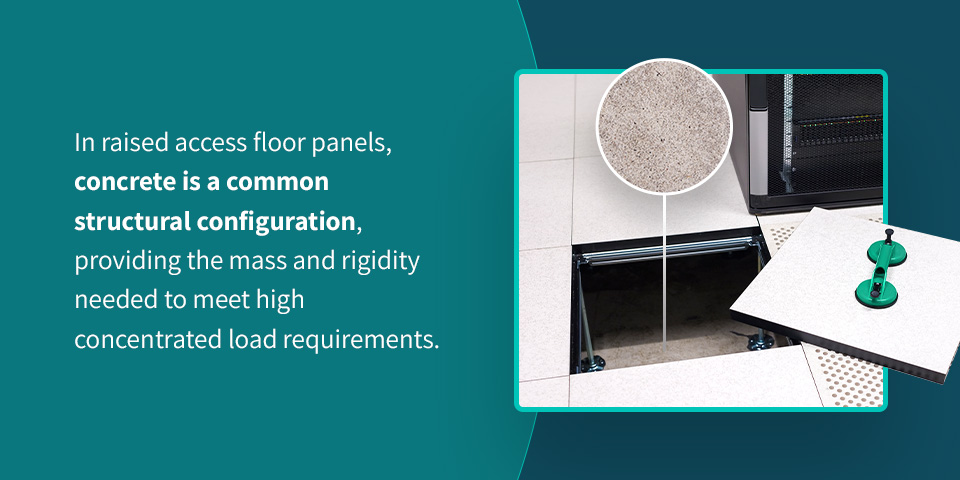
In raised access floor panels, concrete is a common structural configuration, providing the mass and rigidity needed to meet high concentrated load requirements.
ESD Compliance
Raw concrete slabs are electrically resistive and do not inherently dissipate static charge. Where concrete data center flooring is used as the finished surface and ESD protection is required, conductive epoxy coatings can be applied to bring the surface into compliance with applicable standards. Correctly identifying concrete’s role in the floor system is a prerequisite for accurate ESD planning and material specification.
4. Vinyl Flooring
Vinyl ESD tiles and sheet flooring are surface-layer materials installed over a concrete slab or as the finish on raised floor panels. Available in both static-dissipative and conductive grades, vinyl is an ESD flooring category that spans both classifications.
Dissipative vinyl is the standard specification for data center computer rooms where components are enclosed in server assemblies. Conductive vinyl applies where components are handled and direct charge dissipation is required.
Vinyl tiles are cost-effective and available in heat-welded seamless configurations. Their modular format makes vinyl flooring well-suited to phased upgrades and live-environment subfloor work, with a maintenance profile that accommodates active production floors.
5. Rubber Flooring
ESD rubber flooring is a static-dissipative surface material available in the dissipative range. It is well-suited for computer rooms and data center environments where dissipative protection is the specification requirement.
Mechanical durability is rubber’s primary differentiator. It offers strong abrasion resistance, rolling load capacity and inherent slip resistance under continuous caster chair cycling and heavy equipment traffic.
For facilities with high foot and equipment traffic, rubber’s mechanical durability and slip resistance make it a strong long-term fit.
How to Choose the Right Data Center Flooring Vendor
Flooring type and vendor selection are interdependent. Selection should prioritize cross-system assessment experience, not just product availability. The full project scope benefits from a partner with experience across multiple flooring systems.
As data center capacity expands, providers with technical range and life cycle support are better positioned to scale with infrastructure requirements.
Effective evaluation should consider the full operating environment, including cooling topology, rack density, load path, ESD requirements, maintenance access and refresh cycles. Flooring decisions affect more than surface material selection — they influence how the facility adapts to equipment changes, containment strategies and live-environment maintenance requirements over time.
Selection criteria should include:
- Full-range expertise: Prioritize vendors with installation experience across all major floor types. A vendor with that range can match the specification to a facility’s actual cooling architecture, density requirements and operational constraints.
- Zero-downtime capability: Live floor replacement involves replacing the raised floor system while a facility remains operational. Vendors should have documented experience executing live replacements with minimal operational disruption.
- Infrastructure assessment: A qualified vendor conducts a pre-replacement assessment that evaluates floor age, load-bearing capacity, load distribution, airflow implications and ESD compliance. Addressing data center floor replacement considerations up front supports accurate project scoping and reduces execution risk.
- Cleaning and maintenance: Subfloor contamination, including zinc whiskers, can cause equipment failures that present as power supply faults. Vendors offering subfloor cleaning and zinc whisker remediation extend system reliability across the full life cycle.
Partner With DataSpan for Your Data Center Flooring Needs
DataSpan has 50 years of infrastructure experience in data center flooring installation, replacement and repair. We assess facility requirements, specify the appropriate floor system and execute installation or replacement using zero-downtime processes.
Whether your facility is specifying a new build or evaluating material upgrades, our team has the technical depth to scope the project accurately and deliver the right outcome. Contact us today to get started.

About the Author: With a distinguished career that began as a USAF officer managing worldwide office automation policies and programs at the Pentagon, Jim transitioned to the private sector as Vice President NA of Business Development for a UK-based company specializing in Near Field Communication (NFC) and Radio Frequency Identification (RFID) integrated circuit design. Over the past 17 years, he has led DataSpan’s RFID program and project management initiatives as Director of Data Security Technology. Currently, he is leveraging his technical and business experience to help drive DataSpan future growth through AI technology advancements.