

Turning Hot Air Into ‘Free’ IT Capacity
The explosive growth of AI and hyperscale computing is reshaping the data center industry, but it’s exposing a painful truth: a massive amount of valuable energy is being thrown away as unrecovered or unrecycled thermal energy. Most of every kilowatt-hour you pay to run your IT equipment is eventually converted into unrecovered or unrecycled thermal energy that is simply rejected from your facility. This unrecovered waste heat, historically released into the atmosphere, represents a monumental economic loss for the global market.
The industry is treating the immense heat generated by IT hardware like disposable scrap metal or used paper — except they’re not only failing to recycle it, they’re also missing out on billions of dollars in marketable energy and avoiding the systemic costs of that lost power.
The scale of the problem is increasing exponentially: modern AI racks can require 50-80 kW of power or more, compared to just 2-4 kW for traditional enterprise racks. Liquid cooling is now essential to handle this density.
By not capitalizing on this thermal resource, the industry contributes to climate hazards that could drive up annual running costs globally by $81 billion by 2035, according to an analysis by the World Economic Forum.
But what if you could capture that wasted heat and convert it back into power?
Our team and our partner have scaled a breakthrough technology that does exactly this, transforming thermal waste into a primary, on-site and firm power source of up to 30 MW of electricity.
Converting Waste Heat to Electricity Technology
The biggest delay in modern data center construction is the years-long wait for utility upgrades. Our partner’s modular system fundamentally compresses your operational timeline by being rapidly deployable.
The modular design, U.S.-based remote factory construction and remote testing mean installation time is dramatically cut, allowing for parallel commissioning of compute and cooling capacity. This solves the speed-to-power challenge and allows you to achieve “First Rack Online” years ahead of grid infrastructure upgrade timelines. Plus, the modular structure allows for easy scaling later as your power needs grow, ensuring future-proof expansion.
The Up to 30 MW Advantage: Power You’ve Already Paid For
Think of the heat flowing out of your facility as energy you already own. You paid the utility for the electricity that powers the CPUs, GPUs and even the cooling systems. The integrated system developed by our partner essentially creates a closed-loop energy economy.
By recovering and converting this existing thermal output into thermal energy storage for data centers, the system generates up to 30 MW of usable electrical power. This is not just an auxiliary function — it’s a significant grid offset that allows you to instantly increase your firm’s IT load capacity without requiring new, expensive grid connection fees or gas-fired generation investment. It’s power you’ve already paid for, now delivered back to your racks.
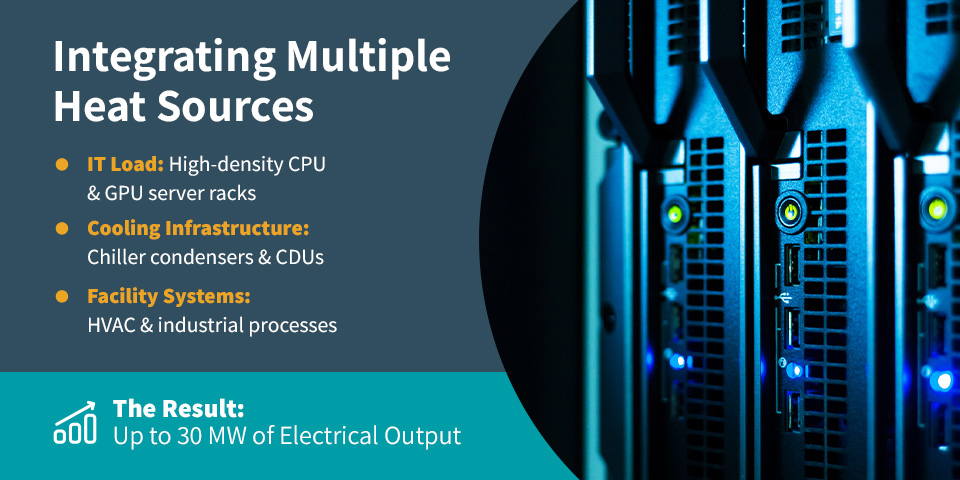
Integrating Multiple Heat Sources for Maximum Recovery
What makes this system so effective is its ability to be integrated with and draw energy from multiple thermal sources simultaneously. It doesn’t rely on just one point of heat — it harvests from all of them.
- IT load & backup power: Waste heat from your high-density CPU and GPU server racks and backup generators
- Cooling infrastructure: Heat captured from chiller condensers and CDUs
- Facility systems: Thermal energy from HVAC systems, industrial processes or even on-site natural gas production facilities
By combining these streams, the system maximizes the available thermal input — which typically runs around 100 to 120 MWth to produce up to 30 MW of electrical output — ensuring you get the most value from every part of your operation.
The Secret to 24/7 Stability: Stored Heat
The true differentiator of this technology is the Thermal Energy Storage System (TESS) module. This component ensures your power generation isn’t tied to the moment heat is produced. By storing the residual energy from waste heat, this system becomes an on-site power generator for data centers — a dispatchable, 24/7 resource.
The TESS achieves this by:
- Storing energy in the most compact and stable form — heat.
- Providing longer-duration resiliency than traditional chemical batteries.
- Using an intelligent control system to strategically convert stored heat to electricity when the load requires it to offset expensive grid power.
As our partner’s Chairman and CTO notes, “Artificial intelligence and energy storage have the power to change the energy sector,” with AI algorithms helping to “manage energy consumption.” This is the intelligence that optimizes the entire system.
By decoupling heat availability from electricity generation, this system provides the long-duration resiliency your modern data center needs, supporting microgrid operations and black-start scenarios while operating with zero emissions.
Ready to Redefine Your Power Strategy?
Waste heat recovery in data centers is not just a theoretical concept. We’ve already proven the viability of this integrated system with successful deployment in critical industrial applications, including an installation at the IBM Bromont, Quebec industrial campus.
This system is ready to help you overcome grid dependency, accelerate your operational timeline and optimize your costs, with up to 30 MW of power production. Rather than losing money on a multibillion-dollar market problem, it turns your waste heat into a scalable revenue stream.
This modular, rapidly deployable system is doubly advantageous, providing both a practical way to reduce waste heat and a tangible cost-saving effort. Early adopters gain a significant competitive advantage by monetizing waste, securing predictable power and deploying high-density AI infrastructure faster than the competition.
To explore how this system can redefine your data center’s speed-to-power timeline and operational resilience, please contact:
Jim Ferguson
DataSpan Director Data Security Technology
M: 972-207-8317


About the Author: Alex von Hassler’s long term focus is the continued testing, learning, and deployment of modern IT solutions. During his years as a DataSpan team member, his responsibilities grew from managing Salesforce CRM to improving system security, creating marketing initiatives, as well as providing continued support to the highly motivated and experienced team in an ever-changing industry. As DataSpan evolves to provide the best-fitting IT solutions to its customers, Alex von Hassler continues to hone his skills in the world of web-based ERP systems, security, and best customer engagement practices. Empowering such a dynamic team with the right tools provides him with enormous gratification.