
The Impacts of Data Center Growth
Data centers are the unseen engines of our digital world, fueling everything from AI innovation to global connectivity. Their rapid expansion sparks vital conversations about resource consumption and environmental impact. Yet, these discussions often overlook the industry’s rapid advancements and proactive strategies.
This article offers a balanced perspective on data center growth. Below, we address key community and environmental concerns while highlighting innovative solutions that enable responsible expansion without compromising technological ambition.
Navigating the Surging Demand for Energy and Water
Data center infrastructure demands are escalating, with energy and water consumption being key areas of focus. However, the industry is actively driving solutions and turning potential constraints into catalysts for innovation.
Addressing Data Center Electricity Demands
Power consumption stems from computational load and thermal management. While server racks generate substantial heat and require continuous cooling, this also drives energy efficiency advancements.
Global data centers are projected to consume increasing amounts of electricity. However, the data center industry is also a primary driver of clean energy procurement, on-site generation, increased power storage and grid infrastructure modernization. This is the result of intensified AI workload demands, which are accelerating investment in sustainable power solutions.
Expertise in computational fluid dynamics (CFD) analysis, for instance, optimizes airflow and cooling efficiency, significantly reducing power usage per rack.
A New Approach to Water Consumption
Cooling systems in hyperscale facilities historically relied on evaporative processes. Now, the industry is rapidly moving toward more water-efficient technologies.
While water consumption remains a consideration, innovative approaches decrease water use. Modern cooling systems are becoming standard as many leading data centers commit to replenishing more water than they consume, aiming to become “water positive” by 2030.
The industry champions these advancements, guiding organizations toward advanced cooling architectures, such as closed-loop cooling and hybrid systems that eliminate significant water-intensive air handling overhead.
Cultivating Positive Environmental and Community Impacts
Beyond resource consumption, data center expansion creates tangible effects on land use, emissions profiles and local economic dynamics. These are opportunities for thoughtful planning and community integration as the industry actively works to minimize its footprint and maximize positive contributions.
Responsible Land Use and Carbon Emissions
Hyperscale facilities are increasingly developed with careful consideration for land-use patterns, steering projects toward established industrial areas or repurposed “brownfield” sites. This reduces undeveloped land and often revitalizes existing zones.
Carbon emissions are tied to power sources, driving a push toward the integration of renewable energy. Clean generation mixes contribute minimally to emissions, and physical infrastructure incorporates sustainable construction materials. To further navigate these complexities, assistance is available to organizations to optimize site selection and implement energy-efficient designs that reduce embodied carbon.
Fostering Community Partnerships and Economic Growth
Data center expansion often brings concerns about local utility strain and rising costs. Yet, the industry is increasingly recognized as a catalyst for grid modernization and economic development. Data centers fund new clean energy initiatives, leverage on-site power to reduce strain and become significant financial contributors to regional infrastructure upgrades.
Modern data centers are designed to be good neighbors, mitigating noise, light and visual disruptions. They also deliver fiscal benefits through tax revenue, infrastructure improvements and long-term workforce development, creating many direct and indirect jobs. These positive engagements demonstrate how data centers, when thoughtfully sited and responsibly developed, can become stable, fiscally beneficial assets that partner with their communities.
How Data Centers Drive Innovation and Progress
Data centers are the foundational infrastructure that enables virtually every aspect of modern business operations, scientific advancement and global connectivity. Their expansion reflects the fundamental shift toward data-intensive processes that drive innovation and societal progress.
Powering Global Connectivity and Growth
Data center infrastructure generates economic value that far exceeds operators’ direct revenue. These facilities power critical systems operating at a massive scale, supporting the digital economy in the following ways:
- Digital commerce platforms process e-commerce transactions representing trillions in annual economic activity.
- Distributed infrastructure enables just-in-time manufacturing and global logistics coordination through supply chain management systems.
- Communication platforms support remote work models that have restructured labor markets and corporate real estate strategies.
- Real-time processing capabilities through financial transaction systems support global banking and payment networks.
- Organizations across all sectors depend on cloud-based enterprise applications for core business operations.
Enabling AI Research and Innovation
AI development requires computational resources that only data centers can provide. Training frontier models demands clusters of specialized processors operating in parallel for extended periods — infrastructure investments that few organizations can replicate independently.
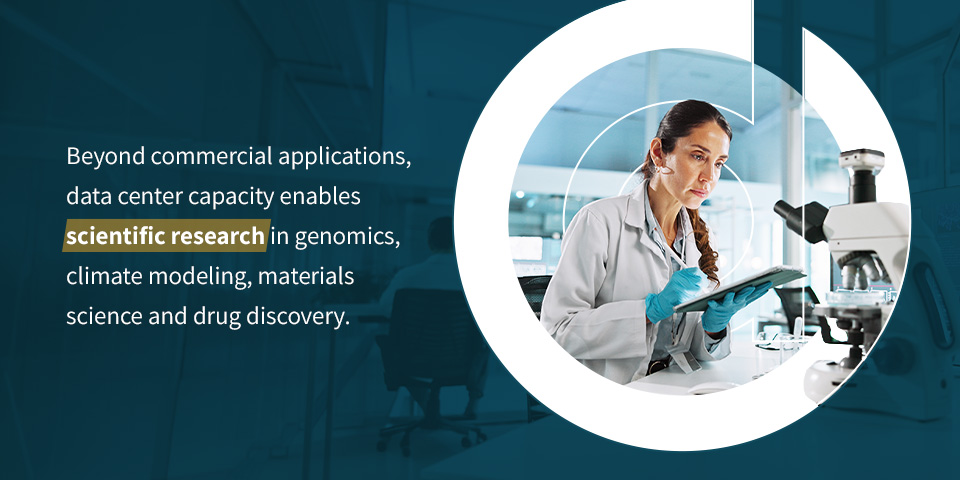
Beyond commercial applications, data center capacity enables scientific research in genomics, climate modeling, materials science and drug discovery. The concentration of computational resources democratizes access, fostering breakthroughs across healthcare, energy systems and advanced manufacturing. Solutions like CFD analysis help ensure these critical innovation engines operate with peak efficiency.
Proactive Strategies for Responsible Growth
The path forward for data centers focuses on responsible expansion. This involves embracing the future through strategic deployment of advanced technologies, renewable energy integration and comprehensive life cycle management. Organizations championing these approaches can expand capacity while effectively managing environmental and community concerns.
Innovations in Efficiency and Cooling
Balancing growth and risk requires smart energy and cooling systems along with improved diagnostics and governance. Advanced cooling architectures represent the most immediate opportunity to reduce energy consumption and water use. Strategic approaches include:
- Liquid cooling: These systems deliver thermal management directly to heat-generating components, virtually eliminating air-handling overhead and improving energy efficiency.
- CFD analysis: Expertise in CFD analysis optimizes airflow, identifying inefficiencies that waste energy.
- Waste heat reuse strategies: Facilities can implement innovative strategies for reusing waste heat to generate additional IT capacity or provide district heating.
These innovations directly improve Power Usage Effectiveness (PUE) ratios and reduce total operating costs, demonstrating ecological responsibility and economic efficiency.
Adopting Renewable Energy Sources
Transitioning data centers to renewable energy is critical for addressing carbon emissions and achieving a sustainable future. Operators increasingly procure dedicated solar and wind capacity through power purchase agreements (PPAs), matching consumption with clean generation.
Besides reducing emissions, powering facilities with renewables mitigates health risks. On-site generation enhances energy security and operational reliability while demonstrating environmental stewardship. Paired with advanced battery storage, renewables help address intermittency and provide backup power, ensuring continuous, clean operation.
Sustainable End-Of-Life Asset Management
Hardware life cycle management is a crucial component of sustainable data center operations. Comprehensive life cycle strategies effectively address electronic waste concerns through:
- Secure data destruction: Sustainable IT Asset Disposition (ITAD) services ensure data is securely erased while maximizing material recovery through certified recycling channels.
- Component refurbishment and remarketing: Asset recycling programs extend equipment life, reducing demand for new manufacturing.
- Certified recycling: Proper material recovery prevents hazardous substances from entering landfills, reclaiming resources and minimizing environmental impact.
These practices close the loop on data center operations, addressing environmental impacts beyond the operational phase and reinforcing a commitment to sustainability.
Partner With DataSpan for Sustainable Growth
Data center growth presents immense opportunity and obligation to the environment and communities. Harnessing the benefits of expanded capacity while managing impact requires strategic foresight and technical expertise.
DataSpan brings 50 years of experience helping organizations navigate this landscape as a trusted partner. From advanced CFD analysis that optimizes efficiency and reduces resource consumption to sustainable ITAD that ensures responsible end-of-life management, our data center services support the full life cycle of infrastructure growth.
As the industry evolves, partnering with an experienced advisor becomes essential. DataSpan provides the technical solutions and strategic guidance to help your organization grow responsibly and sustainably. Let’s discuss how our efficiency analysis and life cycle management capabilities can support your organization as you navigate data center expansion challenges — and turn sustainability goals into tangible achievements.
About the Author: With a distinguished career that began as a USAF officer managing worldwide office automation policies and programs at the Pentagon, Jim transitioned to the private sector as Vice President NA of Business Development for a UK-based company specializing in Near Field Communication (NFC) and Radio Frequency Identification (RFID) integrated circuit design. Over the past 17 years, he has led DataSpan’s RFID program and project management initiatives as Director of Data Security Technology. Currently, he is leveraging his technical and business experience to help drive DataSpan future growth through AI technology advancements.