
The Benefits of Raised Floor Systems
AI adoption, edge deployments and high-density compute are converging to push power and cooling demands beyond the thresholds traditional facilities were designed for — while sustainability mandates tighten and energy costs climb. Data center electricity consumption is on track to more than double by 2030, driven primarily by AI workloads. This trajectory demands infrastructure decisions made today that will hold up under tomorrow’s loads.
For decision-makers tasked with scaling capacity while controlling costs and meeting corporate sustainability goals, raised floor systems are a proven solution. Learn how raised floor infrastructure can support large data centers and in-house computer rooms.
Why Raised Floors Are a Foundational Asset
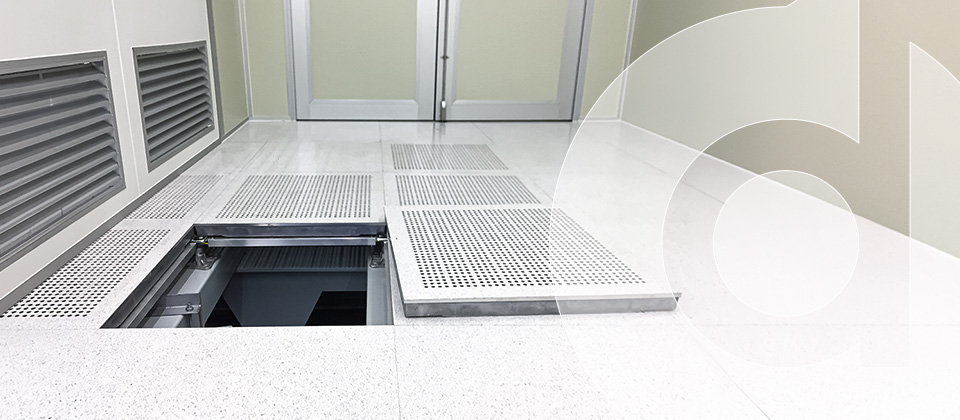
A raised floor system creates a controlled plenum between a room’s finished floor surface and its concrete substrate. Adjustable pedestals support modular floor tiles above this space, creating a pressurized underfloor cavity that serves as the primary conduit for airflow, power distribution and structured cabling. Height adjustments accommodate specific plenum depth requirements, while mechanical anchoring or adhesive systems secure the pedestals based on load ratings and site conditions.
In critical IT environments, the underfloor plenum is a core infrastructure asset. It allows precision management of airflow, power and cabling at scale. The advantages of raised floor systems extend across four critical dimensions of data center performance:
- Cooling efficiency
- Scalability
- Cable management
- Total cost of ownership
1. Optimize Cooling Efficiency and High-Density Demands
Thermal management is the defining infrastructure challenge of the high-density era. Raised access flooring addresses it at the architectural level, giving operators precise control over airflow delivery and containment across the entire facility footprint.
Maximize Airflow for Performance and PUE
Underfloor air distribution (UFAD) is one of the most significant advantages of raised floors. By pressurizing the plenum and delivering conditioned air through perforated or grated tiles at the base of equipment rows, UFAD achieves precise, targeted cooling directly at the inlet of hot-aisle and cold-aisle servers and other critical hardware.
This process supports effective hot/cold aisle containment, keeping cold supply air and hot exhaust air cleanly segregated. The result is a measurable improvement in cooling efficiency that overhead systems cannot replicate. That efficiency directly impacts power usage effectiveness (PUE).
New facilities designed for efficiency are achieving PUEs of 1.3 or better, with optimized cooling design as a key factor. At scale, even incremental PUE improvements can substantially reduce energy costs.
Manage the Heat Demands of High-Density Equipment
Rack densities have increased sharply across the industry. Virtualization, converged infrastructure and GPU-accelerated compute for AI have fundamentally changed the thermal profile of modern facilities. More than half of North American data centers already have racks deployed at densities exceeding 50kW. This figure is expected to climb over the next decade.
At those density levels, traditional perimeter air cooling is no longer adequate. Raised-floor access to the underfloor plenum allows the operational deployment of advanced cooling solutions. This includes direct liquid cooling and rear-door heat exchangers, without wholesale infrastructure redesign. The raised floor becomes the physical foundation that high-density cooling architectures demand.
2. Achieve Scalability and Future-Proof Your Infrastructure
The pace of change in compute technology makes long-term infrastructure flexibility a strategic requirement. Raised floor systems deliver that flexibility through two critical mechanisms — modular architecture that adapts to evolving equipment needs and accessible design that streamlines ongoing maintenance and upgrades.
Adapt to New Technology With Modular Design
Adding grated tiles to improve airflow in a high-density zone or repositioning floor diffusers around a new rack layout is a low-disruption operation. This flexibility becomes increasingly important as data center design requirements evolve. Facilities without floor-level adaptability face costly retrofits or operational constraints that limit their ability to adopt new compute platforms. A raised floor eliminates that lock-in from the ground up.
Streamline Upgrades and Maintenance With Minimal Disruption
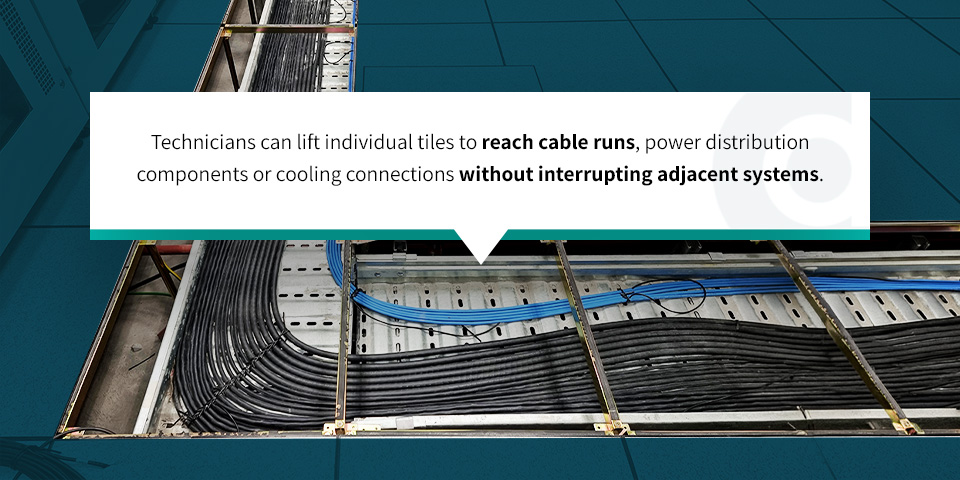
Raised-floor access also significantly reduces the complexity of routine maintenance and infrastructure upgrades. Technicians can lift individual tiles to reach cable runs, power distribution components or cooling connections without interrupting adjacent systems. Troubleshooting and reconfiguration times are significantly shorter than with overhead cable management.
Floor replacement and repair services are designed to support ongoing operational agility, with minimal disruption to live environments.
3. Simplify Complex Cable and Power Management
Cable density scales with compute density. Without a disciplined routing strategy, the physical layer becomes a liability. To keep power and data cabling organized, accessible and compliant, the underfloor plenum provides the dedicated infrastructure space needed.
Improve Safety and Accessibility
Dense server environments generate equally dense cabling requirements. Without a structured routing approach, the result is overhead and floor-level cable accumulation that creates operational hazards and a maintenance burden.
Routing power and data cables through the underfloor plenum eliminates trip hazards, removes cables from hot-aisle exposure and creates an organized rack-and-aisle environment that directly impacts facility efficiency. Raised-floor access also allows individual cable runs to be traced, replaced or extended without disturbing adjacent infrastructure.
Support Structured Cabling for Reliable Performance
The underfloor plenum facilitates the practical implementation of a standards-compliant structured cabling architecture aligned with frameworks like TIA-942, published by the American National Standards Institute (ANSI) and Telecommunications Industry Association (TIA).
Properly structured cabling is a prerequisite for network performance, reliability and physical-layer auditability. A raised floor provides the space needed to implement horizontal and vertical distribution correctly. This becomes increasingly critical as bandwidth demands grow.
4. Lower Operational Costs and Improve Total Cost of Ownership
Raised floor infrastructure delivers measurable cost reductions across the facility life cycle, from reduced energy spend to lower maintenance burden.
Quantify Energy Savings From Efficient Cooling
Cooling is one of the largest line items in any data center’s operational budget — it can account for over 30% of total electricity consumption in less-efficient facilities. Improving cooling efficiency through UFAD and containment produces measurable, sustained reductions in energy spend.
For large-scale facilities, reducing the PUE from 1.8 to 1.5 or lower can yield millions of dollars in annual savings. Those gains also support sustainability and emissions reporting commitments, making a case relevant to operations teams and the C-suite.
Reduce Costs Associated With Downtime and Maintenance
Thermal system failures are expensive. For example, in May 2026, a thermal event at an Amazon Web Services data center in Northern Virginia caused servers to automatically shut down when temperatures exceeded operating thresholds. The result was a multi-hour outage that disrupted EC2 and EBS services across the US-East-1 region. In November 2025, a chiller plant failure forced CME Group to halt global futures and options trading for about 10 hours.
Thermal events are a predictable risk for any facility that has not engineered cooling precision and redundancy into its infrastructure. The up-front investment in a raised floor system, paired with proactive IT asset auditing and management, is both a risk-mitigation and cost-reduction strategy. When compared to the cost of a single unplanned outage, the ROI becomes clear.
Get Started With DataSpan
Raised floor systems are a strategic investment in the cooling efficiency, scalability and financial performance of modern data centers and computer rooms. This makes them one of the smartest infrastructure decisions for facilities scaling to meet the demands of AI, high-density compute and tightening sustainability mandates.
DataSpan has engineered raised floor solutions for data centers for 50 years. We assess your thermal management requirements, layout constraints and capacity projections, then specify the system that fits. There’s a reason our client list includes more than half of the Fortune 1000.
To learn more, find your nearest rep or contact us today.