
Reasons You May Be Experiencing Issues With Your Data Center Floor
Data center flooring is a critical infrastructure component that affects cooling efficiency, equipment reliability and operational safety. When issues arise, they can manifest as subtle signs — a slight panel deflection, an unexplained equipment failure or a gradual increase in cooling costs.
Understanding the nine structural and environmental risks that cause data center flooring issues empowers you to move from troubleshooting to implementing a targeted solution.
Structural and Load-Related Failures
Structural failures are the most critical category of flooring issues a data center can experience. They compromise the system’s physical integrity while creating immediate safety risks for personnel and equipment.
1. Inadequate Structural Load Ratings
Raised access flooring systems must accommodate concentrated loads from static rack weight, rolling loads from moving heavy equipment and ultimate load capacity for a safety margin. Office-grade flooring cannot handle modern data center hardware demands.
Data center equipment cabinets can weigh 2,800 to 3,000 pounds. A properly specified floor must account for whether tiles have been modified for heavier loads and whether the subfloor can support equipment moving across it.
Rolling loads from transporting servers can cause dish-shaped panel deformations if the system isn’t rated for dynamic stress, compromising panel integrity and accelerating wear on adjacent components.
Facilities experiencing unexplained hardware failures or raised floor system instability should evaluate whether their current flooring meets the load requirements of their installed equipment density.
2. Pedestal and Stringer Instability
Panel rocking is one of the most common reasons you may be experiencing issues with your data center floor. When pedestals are not perfectly vertical or stringers become loose, vertical load transfer fails and the safety margin across the grid is reduced. Pedestals that lean even slightly cannot effectively transfer loads to the subfloor, while loose stringers allow panels to shift and propagate movement through the grid.
If you notice panels that shift when walked on or audible creaking during normal traffic, professional floor replacement and repair services can identify whether pedestal or stringer issues are the root cause.
3. Poor Subfloor Preparation and Flatness
An uneven subfloor forces pedestals out of plumb, magnifying deviations as pedestal height increases and creating instability that no adjustment can correct.
ASTM E1155 provides the standard method for measuring floor flatness and levelness. Data center subfloors require adequate flatness tolerances to ensure proper pedestal alignment. Facilities built without proper subfloor preparation often experience chronic rocking panels and accelerated component wear. The concrete must also be properly sealed to prevent dusting and moisture migration into the plenum space.
Subfloor preparation also impacts cooling efficiency and equipment longevity. This connection between foundation and performance is even more apparent when examining environmental risks.
Environmental and Contamination Risks
While structural integrity is essential, environmental factors within the subfloor plenum and throughout the raised floor system can lead to equipment damage, data center outages and increased operating costs.
4. Subfloor Moisture and Particulate Contamination
Unsealed concrete releases fine dust particles through a process called dusting. These particles enter the cooling airstream through cable cutouts and perforated tiles, eventually reaching server intakes where they accumulate on components and impede heat transfer.
Water vapor can also penetrate inadequately sealed concrete, leading to corrosion of steel pedestals and support structures. In severe cases, moisture creates ideal conditions for biological contaminants, which compromise air quality and structural components.
ASTM F710 standards specify concrete floor preparation to address dust and moisture concerns. Facilities experiencing frequent hardware cleaning cycles or unexplained corrosion should evaluate their subfloor sealing. Data center cleaning and consulting services can assess contamination levels and recommend remediation strategies.
Proper selection and preparation of flooring materials impact equipment reliability through contamination control, thermal management and airflow efficiency.
5. Uncontrolled Electrostatic Discharge
Electrostatic discharge (ESD) that poses no noticeable risk to personnel can damage sensitive electronics. Improper floor materials or inadequate maintenance create conditions where static buildup may become inevitable.
Data center flooring materials must maintain appropriate surface resistance levels to prevent static accumulation while ensuring personnel safety. Factors that affect ESD performance include floor material composition, humidity levels and contamination on tile surfaces.
6. Compromised Airflow and Cooling
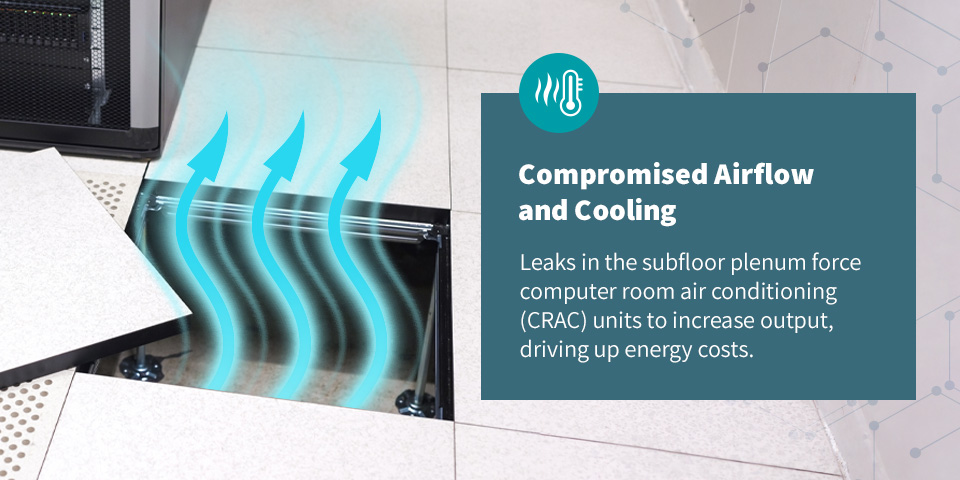
Raised floor systems function as pressurized plenums that deliver conditioned air to equipment intakes. Unsealed cable cutouts, improperly placed perforated tiles and gaps around floor penetrations create bypass airflow that undermines this delivery system. When cooled air escapes before reaching its destination, hot spots develop and cooling systems work harder to compensate.
Leaks in the subfloor plenum force computer room air conditioning (CRAC) units to increase output, driving up energy costs. Hot exhaust air can recirculate through gaps under racks, creating localized thermal problems that reduce hardware lifespan.
Sealing gaps under IT racks eliminates a common source of bypass airflow. When considering solutions, the entire cooling architecture, including containment and airflow management systems, may need to be evaluated.
7. Zinc Whisker Growth
Zinc whiskers are microscopic metallic filaments that can form on galvanized steel components, including the underside of older floor tiles and plenum support structures. These hair-like growths develop over years as zinc plating experiences compressive stress. When they break off and become airborne, they create risk.
Zinc whiskers can enter equipment intakes and cause short circuits on server motherboards, network switches and other sensitive electronics. A single whisker bridging two circuit traces can cause immediate hardware failure. The problem is particularly acute in facilities with older flooring systems installed before manufacturers addressed zinc whisker formation.
Air-side economizers achieve cooling energy savings, with studies reporting reductions of 47.5% to 67.2% in annual cooling energy use. However, economizers increase outside air volume, which can exacerbate particulate contamination risks, including zinc whisker distribution if older galvanized components are present.
The transition from environmental risks to operational failures often occurs gradually, making prevention through proper installation and maintenance essential.
Installation and Maintenance Deficiencies
Even the highest-quality flooring system will fail prematurely if installed incorrectly or neglected over time. The human element in data center flooring represents a controllable risk that directly impacts long-term reliability.
8. Improper Initial Installation
Certified installers ensure every component functions as an integrated system. Common installation errors include failing to secure pedestals properly, not verifying the grid is level and neglecting torque specifications on bolted stringers.
The expertise required for proper installation extends beyond mechanical assembly. Installers must understand load paths, thermal expansion considerations and how the flooring system integrates with cooling infrastructure. Facilities planning new installations or major modifications should engage experienced data center service providers who understand these interdependencies.
9. Lack of Routine Maintenance
The longevity of a raised flooring system depends on regular inspection schedules that identify problems before they escalate into failures. Understanding the impact of flooring on efficiency helps prioritize maintenance activities.
How to Audit and Address Flooring Issues
Facility managers can conduct preliminary assessments using visual inspection and basic testing. However, confirming root causes and developing remediation plans typically requires specialized expertise and equipment.
Conducting a Visual Assessment
Walk the floor area and document the following indicators:
- Rocking or shifting panels when walked on indicates lateral instability or inadequate support.
- Visible gaps between panels, uneven surfaces or misaligned tiles suggest structural settling or improper installation.
- Delaminating tile surfaces, cracked panels or visible corrosion on exposed metal components signal age-related failures.
- Creaking sounds during normal foot traffic indicate loose connections or compromised structural integrity.
- Equipment temperature alarms or hot spots near specific floor areas may indicate airflow problems.
Document findings with photographs and floor location references to establish a baseline assessment that helps prioritize which areas require detailed investigation.
Performing Key Environmental Tests
Invisible problems require specialized testing equipment. Consider these key evaluations:
- Air quality testing in the plenum space identifies contamination sources and severity levels.
- Measuring ohmic resistance verifies ESD compliance across different floor areas and materials.
- Documenting pressure variations between the plenum and room space reveals bypass airflow locations.
- Infrared cameras identify hot spots and cooling inefficiencies invisible to visual inspection.
When to Engage a Professional
Professional audits are necessary when testing reveals problems beyond your remediation capabilities. Complex issues involving structural reinforcement or floor replacement require engineering expertise.
Facilities experiencing recurring operational disruptions, unexplained hardware failures or increasing maintenance costs should schedule comprehensive professional assessments.
Get Started With DataSpan
For 50 years, DataSpan has engineered custom solutions for data center challenges — and flooring issues are no exception. If you’re experiencing issues with your data center floor, our team can diagnose the root cause and implement a fix without disrupting operations.
We serve over half of the Fortune 1000 because we understand that your data center’s foundation establishes the basis for uptime, efficiency and long-term reliability. Contact us or find your local rep to discuss your facility’s specific needs.


About the Author: Alex von Hassler’s long term focus is the continued testing, learning, and deployment of modern IT solutions. During his years as a DataSpan team member, his responsibilities grew from managing Salesforce CRM to improving system security, creating marketing initiatives, as well as providing continued support to the highly motivated and experienced team in an ever-changing industry. As DataSpan evolves to provide the best-fitting IT solutions to its customers, Alex von Hassler continues to hone his skills in the world of web-based ERP systems, security, and best customer engagement practices. Empowering such a dynamic team with the right tools provides him with enormous gratification.